
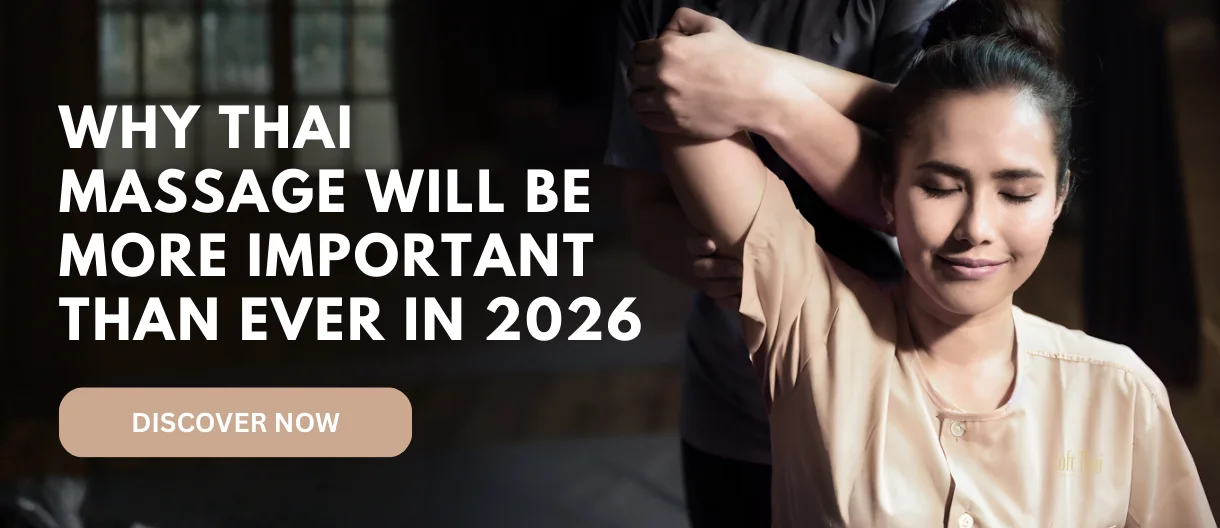
As the world moves toward 2026, one thing is becoming increasingly clear: modern life is exhausting us in ways we are only beginning to understand. Longer working hours, constant digital stimulation, blurred boundaries between personal and professional life, and rising mental health challenges have quietly reshaped how our bodies and minds function. In this context, wellness is no longer about indulgence or occasional self-care—it has become a necessity for survival and balance.
Among all holistic practices, Thai massage stands out as one of the most relevant and essential therapies for the years ahead. Rooted in centuries-old wisdom yet perfectly aligned with contemporary needs, Thai massage responds directly to the physical, emotional, and neurological pressures defining modern life. In 2026, its role will extend far beyond relaxation; it will become a cornerstone of sustainable health, mental clarity, and long-term resilience.
The Mental Health Crisis Defining the Mid-2020s
The global conversation around mental health has shifted dramatically over the past few years. Burnout is no longer limited to high-powered executives or medical professionals; it now affects students, creatives, entrepreneurs, remote workers, and even teenagers. The pace of life has accelerated, but our nervous systems have not evolved to cope with this constant stimulation.
By 2026, stress will not simply be a temporary condition—it will be a chronic state for many people. Anxiety, sleep disorders, emotional fatigue, and concentration difficulties are increasingly common symptoms of a deeper imbalance. While therapy, medication, and digital wellness apps all play a role, they often overlook one fundamental truth: mental health is inseparable from the body.
This is where Thai massage becomes uniquely important. Unlike treatments that focus solely on muscles or surface-level relaxation, Thai massage works holistically—addressing physical tension, energy flow, breath, posture, and nervous system regulation simultaneously. It treats the body as a gateway to calming the mind.
Digital Fatigue: The New Invisible Illness
One of the defining conditions of our era is digital fatigue. Endless screen time, constant notifications, artificial light exposure, and cognitive overload have created a state of continuous alertness. Even during rest, the brain struggles to fully disconnect. This perpetual “on” mode disrupts sleep cycles, increases cortisol levels, and prevents true recovery.
Thai massage offers something rare in a hyperconnected world: a complete sensory reset. The practice emphasizes slow, rhythmic movements, mindful pressure, deep stretching, and guided breathing. These elements activate the parasympathetic nervous system—the part responsible for rest, digestion, and healing.
In 2026, as people seek genuine solutions to digital burnout, Thai massage will increasingly be recognized as one of the most effective forms of stress relief. It does not simply help people relax; it retrains the body and mind to remember what deep rest feels like.
From Luxury to Essential Wellness Practice
Historically, massage has often been perceived as a luxury—something reserved for vacations, special occasions, or spa days. That perception is rapidly changing. The wellness landscape of 2026 is defined by prevention rather than reaction. People no longer want to wait until they are exhausted, injured, or emotionally depleted to take action.
Thai massage fits perfectly into this new mindset. Its benefits are cumulative, meaning regular sessions contribute to long-term physical health, emotional stability, and mental clarity. Instead of offering temporary relief, it supports the body’s natural ability to maintain balance over time.
As healthcare costs rise and awareness of stress-related illnesses grows, more individuals will turn to holistic therapies as part of their regular health routine. Thai massage, with its deep therapeutic roots and proven effectiveness, will stand out as a practice that delivers measurable, lasting benefits.
Thai Massage Benefits in 2026: A Holistic Response to Modern Life
The relevance of Thai massage in 2026 lies in how precisely it addresses the challenges of contemporary living. Physically, it counteracts the effects of sedentary lifestyles—poor posture, muscle stiffness, reduced mobility, and chronic pain caused by long hours of sitting. Through assisted stretching and targeted pressure, Thai massage restores flexibility, improves circulation, and rebalances the musculoskeletal system.
Mentally, it creates space. The structured rhythm of a Thai massage session allows the mind to slow down naturally, without force or effort. Many people experience a meditative state during treatment, even if they struggle with meditation in daily life. This mental quietness is not accidental; it is the result of intentional techniques designed to calm the nervous system.
Emotionally, Thai massage offers grounding. Touch, when applied with skill and intention, has profound psychological effects. It fosters a sense of safety, presence, and reconnection with the body—something many people lose in a world dominated by screens and schedules.
These combined effects make Thai massage particularly powerful for stress relief in 2026, when stress is no longer episodic but embedded in everyday life.
Burnout Culture and the Need for Body-Based Healing
Burnout is not just about working too much; it is about never fully recovering. Modern culture often glorifies productivity while ignoring restoration. Even leisure activities are frequently overstimulating, leaving little room for genuine rest.
Thai massage addresses burnout at its core by creating a structured environment where the body is allowed to let go completely. Unlike passive relaxation, it engages the body actively through movement and stretching, helping release deeply held tension patterns that accumulate over months or years.
In 2026, as burnout becomes more widely recognized as a serious health condition, body-based therapies like Thai massage will gain greater legitimacy. They offer something talk-based or digital solutions cannot: direct, physical intervention in the stress response cycle.
A Holistic Wellness Philosophy for the Future
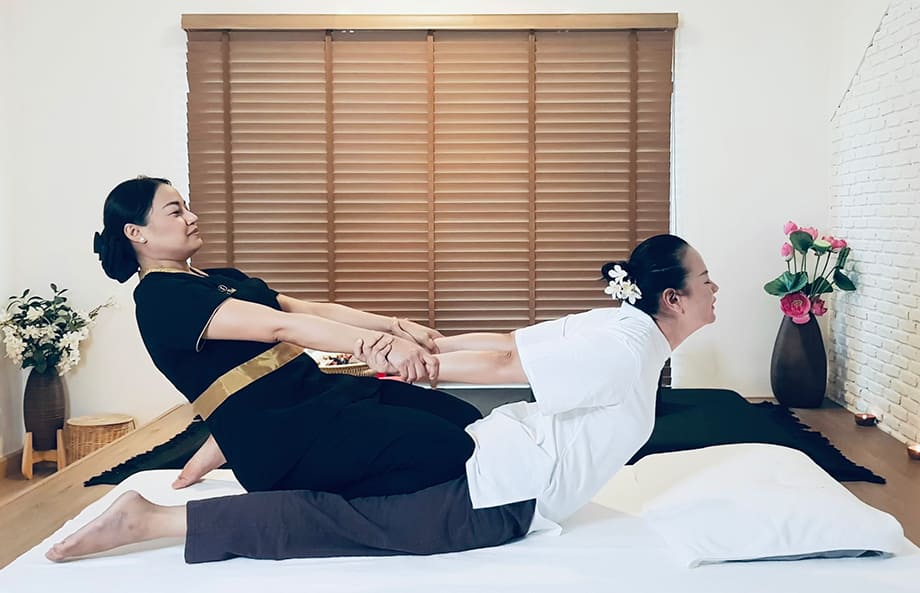
At its heart, Thai massage is built on a holistic philosophy that feels increasingly relevant today. It is based on the concept that health is the result of balance—between effort and rest, movement and stillness, body and mind. This philosophy contrasts sharply with the fragmented approach of modern healthcare, which often treats symptoms in isolation.
As people become more informed and intentional about their health choices in 2026, they will gravitate toward practices that address the whole person rather than individual problems. Thai massage does exactly that, making it a natural pillar of holistic wellness in the years ahead.
Why 2026 Marks a Turning Point
The year 2026 represents more than a future date; it symbolizes a shift in collective awareness. The effects of prolonged stress, digital overload, and emotional fatigue are no longer abstract—they are visible in workplaces, families, and societies. In response, people are redefining what it means to be healthy.
Thai massage aligns seamlessly with this shift. It is ancient yet adaptable, deeply therapeutic yet accessible, and grounded in human connection rather than technology. As wellness continues to evolve, Thai massage will not be replaced by trends or apps—it will be rediscovered, respected, and integrated more deeply into everyday life.
Thai Massage as a Necessity, Not an Escape
In 2026, Thai massage will matter more than ever because it answers the most urgent needs of our time. It provides relief from stress without numbing, healing without dependency, and restoration without escape. It reminds us that the body is not a machine to be pushed endlessly, but a living system that requires care, attention, and balance.
As mental health, burnout, and digital fatigue continue to define modern life, Thai massage will stand as one of the most powerful tools for maintaining wellbeing. Not as a luxury reserved for special moments, but as an essential practice for living well in an increasingly demanding world.
In the years ahead, the question will no longer be why people choose Thai massage—but how they ever managed without it.
UPDATED LOFT THAI GUIDE
Additional guidance and current information
The following editorial update expands on the original Loft Thai article with practical context, current treatment guidance and further reading.
Importance Without the 2026 Hype
The original article described Thai massage as a future necessity and connected it to burnout, chronic stress, poor posture, sleep problems, circulation, emotional stability and long-term health. Those claims asked a wellness service to carry more certainty than the evidence supports.
Massage research has explored pain, stress and other outcomes, but the US National Center for Complementary and Integrative Health notes that evidence varies by condition and study quality. Massage also has safety considerations. A commercial Thai massage should therefore be presented as supportive wellness care, not a treatment for a list of modern disorders.
Its 2026 importance is cultural and practical. Guests can encounter a Thai form of bodywork, learn what distinguishes it from oil massage and make informed choices about pressure, position and assisted movement. That is a strong proposition without medical exaggeration.
Nuad Thai Is Living Cultural Heritage
UNESCO inscribed Nuad Thai on the Representative List of the Intangible Cultural Heritage of Humanity in 2019. Its description places the practice within traditional Thai healthcare and highlights knowledge transmitted through families, temples, schools and professional organisations.
The inscription does not certify every spa, sequence or health claim. It recognises a cultural practice and the communities that sustain it. That distinction matters because heritage should not be reduced to a decorative wai, a costume or an exotic menu description.
A responsible Bangkok spa can acknowledge variation between teachers and lineages, explain when a treatment is traditional or contemporary and avoid presenting one choreography as the only authentic form. Cultural continuity is stronger when complexity is admitted.
- Name Nuad Thai accurately
- Credit Thai teaching and transmission
- Distinguish clothed Thai work from oil massage
- Explain contemporary signature additions
- Keep cultural recognition separate from medical proof
A Human Practice in an Increasingly Digital Journey
Digital booking can make a Thai massage easier to compare. A guest can check duration, price, branch, room, language and basic preparation before arrival. That convenience is valuable, but it is not the treatment itself.
In the room, the therapist notices breathing, guarding, temperature, movement range and verbal feedback. These observations are not a diagnosis; they guide practical choices such as using a bolster, changing position, reducing leverage or spending less time on a sensitive area.
This responsive exchange is one reason Thai massage remains distinct from a fixed mechanical programme. Human judgement is most valuable when it protects consent and comfort, not when it is romanticised as intuition that overrides what the guest says.
Touch Has Value Only When Boundaries Are Clear
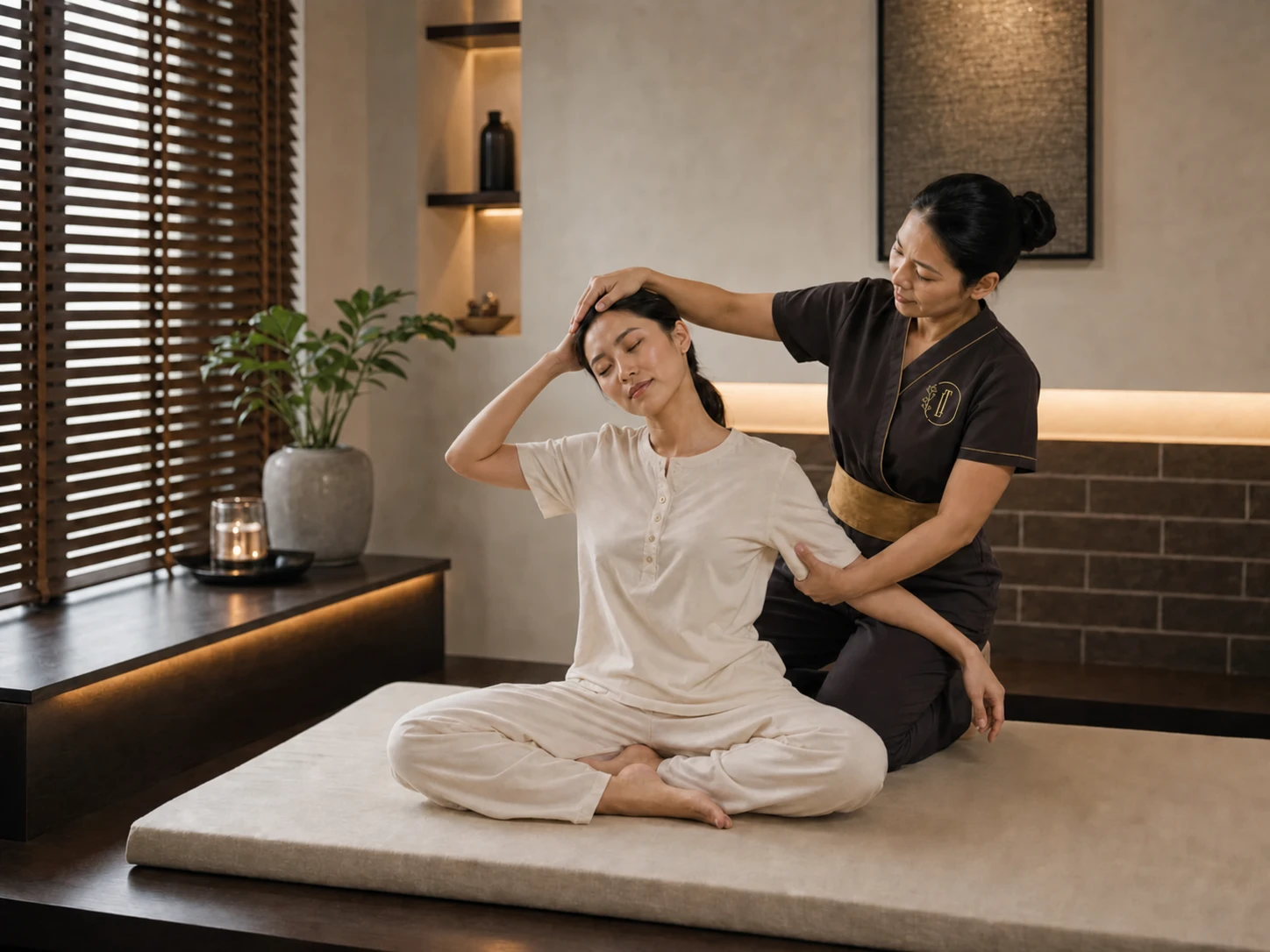
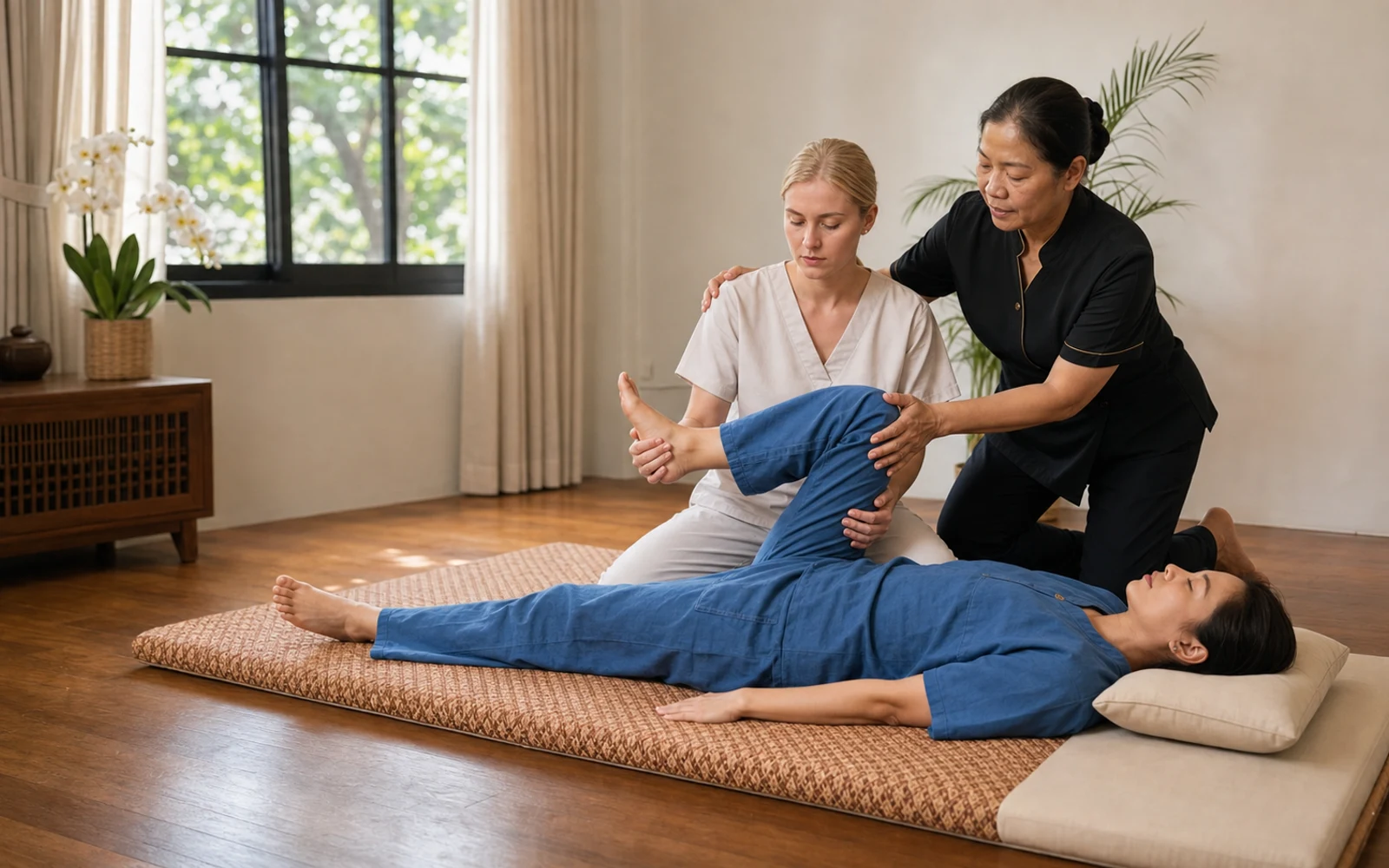
Thai massage may use palms, thumbs, forearms, elbows, knees or feet and can include assisted movement. The variety of contact is part of the form, but it also makes explanation and permission important.
A guest can ask for no stretching, decline abdominal or inner-thigh work, avoid a position, request lighter pressure or stop the treatment. Consent is not completed once at reception; it can change as the session progresses.
Professional draping, private changing instructions and clear anatomical language help remove ambiguity. A cultural tradition is not protected by asking guests to tolerate discomfort or techniques they do not understand.
Training Keeps the Tradition Usable
A memorised sequence cannot answer every body. Training needs to combine cultural context with body mechanics, stable contact, pressure control, hygiene, draping, contraindication awareness and referral boundaries.
Supervised practice lets an educator see details that written material cannot reveal: whether weight transfers gradually, whether a joint is supported and whether the student responds when a partner becomes tense. Those details determine whether a traditional technique feels coherent rather than theatrical.
Continuing education should refine ordinary practice before adding spectacular positions. The quieter abilities—preparing the room, consulting well, adapting and finishing calmly—often protect the integrity of the service.
-
01
Receive
Learn the form, language and cultural context from qualified teaching.
-
02
Practise
Build reliable body mechanics and pacing through supervised repetition.
-
03
Adapt
Modify position, leverage and pressure while preserving the treatment’s logic.
-
04
Transmit
Teach technique together with consent, hygiene and professional boundaries.
What the WHO Strategy Does—and Does Not—Mean
World Health Organization member states adopted the Global Traditional Medicine Strategy 2025–2034 in May 2025. Its objectives include stronger evidence, safety and regulation, appropriate integration and respect for Indigenous and traditional knowledge.
That strategy is not a WHO endorsement of a particular Thai massage spa or a guarantee that massage treats burnout, disease or chronic symptoms. It is a policy framework for how countries can approach traditional, complementary and integrative medicine more responsibly.
For guests, the useful message is caution rather than authority by association. Ask whether a practitioner is trained for the service, whether the spa explains its scope and whether a health claim can be supported independently.
Why Place Still Matters in Bangkok
Thai massage is offered around the world, but Bangkok gives visitors an opportunity to experience it within the country where the practice developed and continues to change. That proximity does not automatically make every service authentic or high quality.
A thoughtful spa can make the context visible through accurate descriptions, Thai-led training, respectful design and a menu that separates traditional Thai massage from blended signatures. It can also welcome international guests without flattening the treatment into a tourist performance.
Luxury, in this setting, is not distance from tradition. It is the ability to give tradition time, clarity, skilled hands and a private environment.
How to Choose Thai Massage in 2026
Start with format. Traditional Thai massage is generally clothed and may combine compression with assisted movement. Oil treatments use glide and require different draping. A signature may blend methods, so ask what is traditional and what has been added.
Then consider intensity and mobility. Stronger is not more authentic. Share injuries, pregnancy, recent procedures, medications and areas to avoid. Unexplained swelling, acute injury, infection, severe pain or neurological symptoms need appropriate clinical assessment rather than a harder massage.
Finally, choose a provider that can describe its training, prices and boundaries without relying on miracle language. The most credible 2026 experience is not the most dramatic; it is the one in which culture, competence and guest choice remain aligned.
- Confirm clothed, oil-based or blended format
- Ask how pressure and stretching can be adapted
- Share relevant health and mobility information privately
- Expect clear prices, durations and inclusions
- Treat cultural recognition as context, not a cure claim
Continuity Is a Professional Choice
Thai massage will remain meaningful in 2026 if the people presenting it resist two shortcuts: turning heritage into spectacle and turning wellness into medicine. Neither serves the guest or the tradition.
Careful consultation, skilled adaptation and honest language may sound less dramatic than predictions about the future of health. In practice, they are what allow a living cultural form to be encountered with confidence.
“A living tradition stays meaningful when its name, context, teachers and limits remain visible.”
Loft Thai Editorial Team
Continue your research
REFERENCES
Sources & further reading
PRACTICAL GUIDANCE
Frequently Asked Questions
Why is Thai massage still relevant in 2026?
It remains a living Thai cultural practice and a distinctive form of wellness bodywork. Its relevance does not depend on claims that it cures modern stress or disease.
Does UNESCO recognition prove health benefits?
No. UNESCO recognises Nuad Thai as intangible cultural heritage; it does not certify commercial providers or establish medical outcomes.
Does the WHO endorse Thai massage?
The WHO strategy addresses traditional medicine broadly and emphasises evidence, safety, regulation and cultural respect. It is not an endorsement of a particular spa or treatment claim.
Should Thai massage be painful to be authentic?
No. Pressure and assisted movement can be adapted, and a guest can decline any technique. Intensity is not a measure of authenticity.
How can I recognise responsible Thai massage in Bangkok?
Look for clear treatment descriptions, trained therapists, private consultation, active consent, professional draping and realistic wellness language.
CONTINUE READING
Related stories
Wellness Trends 2026: How Thai Massage Is Evolving for the Modern Lifestyle
As the world steps into a new era of wellness, 2026 marks a pivotal moment for the global spa and holistic health industry. Wellness is no longer treated as an occasional luxury or a once-a-year retreat—it has become a lifestyle necessity, deeply embedded in…
Read the guide
How Education and Heritage Power the World of Loft Thai Spa
In the competitive landscape of luxury wellness, where every establishment promises tranquility and rejuvenation, true distinction is rarely a matter of chance. It is easy to construct a beautiful room, to light scented candles, and to play soft music that…
Read the guide
Best Thai Massage Thailand: The Loft Thai Story
Inside a Loft Thai treatment room, the first language is rhythm. A therapist settles her stance, listens to the guest’s breathing and lets pressure build without hurry. Hands pause before they move again; every stretch is supported, every change of position…
Read the guide
Meet the Master Therapist Series: A Private Signature Massage Experience with Khun Pie
There are massages you book because your body feels tired. There are spa rituals you choose because you want to escape the noise of the city for an hour. And then there are rare experiences that feel more like a meeting with living knowledge — a moment where…
Read the guide